
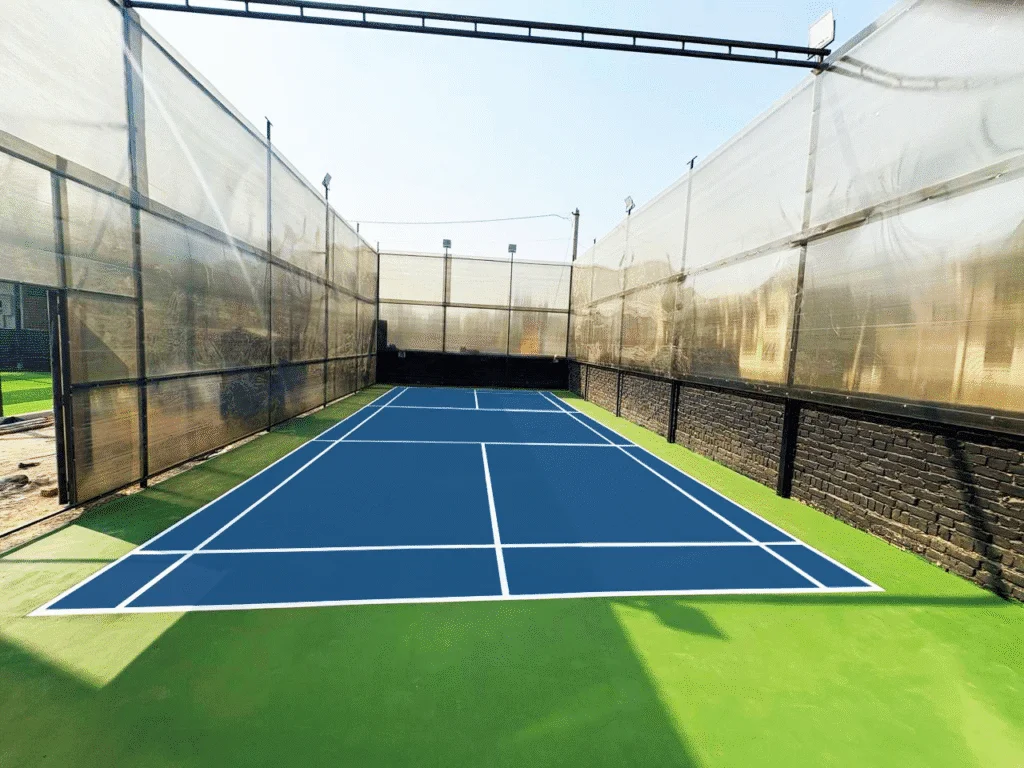
How Synthetic Acrylic Surfaces Are Transforming Courts Across the Nation
Walk into any modern sports complex in India today – a gleaming badminton hall in Bengaluru, a freshly laid tennis court in Ahmedabad, a rooftop pickleball arena in Mumbai – and you will almost certainly be standing on synthetic acrylic flooring. A decade ago, that statement would have been a curiosity. Today, it is simply the standard.
India is in the middle of a quiet but relentless upgrade of its sports infrastructure. Driven by growing grassroots participation, the ambitions of Khelo India, and a new generation of performance-aware athletes and club operators, the country is rethinking what a sports surface should look like, feel like, and last like. At the forefront of this shift is a homegrown category of material – synthetic acrylic sports flooring – and one manufacturer in particular has become synonymous with it: Pacecourt.
Why India’s Old Courts Are Being Left Behind
For the longest time, sports courts in India were built with whatever was cheapest and most available: bare concrete, cracked asphalt, red oxide paint, and the occasional coat of weather-beaten tar. These surfaces were functional at best and hazardous at worst – offering inconsistent ball bounce, dangerous grip variations between dry and wet conditions, and surfaces that punished athletes’ joints with every step.
The toll on player safety was real. Sports physiotherapists across the country consistently point to poor court surfaces as a contributing factor in knee, ankle, and lower-back injuries among recreational and competitive players alike. A surface that has no shock absorption, no consistent grip, and no regulated ball response is not just uncomfortable – it is dangerous.
Beyond safety, there was the problem of maintenance. Concrete courts develop cracks within months in climates with high temperature variation. Paint fades quickly under India’s intense UV exposure. Lines become invisible. Courts that once looked professional deteriorate into something an athlete might actively avoid training on.
The solution, it turned out, was already well understood by the global sports industry. It was simply waiting to be manufactured and distributed at scale within India.
The Science Behind Synthetic Acrylic Surfaces
Synthetic acrylic sports flooring is not a single material – it is a precisely engineered system of layers, each serving a specific purpose. Understanding this layering is key to appreciating why these surfaces outperform everything that came before them.
|
Pacecourt’s Layer System at a Glance
|
|---|
Pacecourt offers both a 5-layer system – which suits most recreational and semi-professional facilities – and an 8-layer system, which delivers ITF-3 (International Tennis Federation) certified performance for tournament-standard tennis courts. The difference matters enormously in practice: the 8-layer system offers deeper cushioning, superior ball response consistency, and a significantly longer surface life.
Critically, the acrylic formulation resists UV degradation, which is a make-or-break factor for outdoor courts exposed to Indian summers. While painted concrete courts typically need resurfacing within 18 to 24 months, properly laid synthetic acrylic courts maintain their performance and appearance for years – in many documented cases, well beyond the standard three-year warranty period.
Pacecourt: India’s First Global Sports Flooring Manufacturer
When Pacecourt was founded, the ambition was straightforward but audacious: build the synthetic acrylic sports flooring materials that India’s courts needed, in India, and distribute them to the world. With 11 years of manufacturing experience and a client portfolio that spans universities, housing societies, corporate campuses, sports academies, and municipal facilities, Pacecourt has established itself as the country’s benchmark brand in this space.
The company is headquartered in New Delhi and supplies materials globally through a network of over 200 independent dealers and contractors. This model – where Pacecourt manufactures and certifies the material, while trained third-party installers handle on-site execution – has proven to be scalable and quality-consistent across wildly different geographies and climates.
What distinguishes Pacecourt from generic acrylic paint suppliers is the depth of its product system. Every layer is engineered to work with every other layer. The Deep Patch is formulated to accept the Concrete Primer; the Primer is designed to bond with the Resurfacer; the Resurfacer creates the correct surface energy for the Cushion Coat to adhere – and so on up the stack. Mixing competing brands’ materials at different layers is one of the most common causes of premature court failure, a problem Pacecourt’s integrated system is designed to eliminate.
The company also offers an unusual degree of aesthetic flexibility. Eight standard court colors are available – including light blue, royal blue, dark blue, grey, grass green, dark green, and terracotta – with custom colors available on request. Paired with the company’s online Court Design Tool and color combination visualizer, this allows schools, academies, and corporate clients to plan and preview their facility before a single bucket of material is ordered.
Court by Court: Sports That Benefit Most
Tennis Courts
Tennis is perhaps where synthetic acrylic flooring has made its most visible global mark. The material is the basis for the hard-court surfaces used at the US Open and Australian Open, and Pacecourt’s ITF-3 certification means its tennis surfaces meet the same international standard. For Indian clubs and academies seeking to train players to international norms, this certification is not a marketing point – it is a functional requirement. Ball bounce, speed, and grip must be predictable and repeatable; synthetic acrylic delivers exactly that.
Badminton Courts
Badminton’s rapid growth in India – from school gyms to dedicated academies producing national-level players – has created an enormous demand for quality indoor and outdoor court surfaces. Synthetic acrylic flooring addresses the two core demands: consistent footing for explosive lateral movement, and a surface that absorbs enough impact to protect players’ knees during sustained training. Pacecourt’s badminton courts are also used in covered outdoor settings, where UV and moisture resistance become critical.
Basketball and Volleyball
Both sports demand high-traction surfaces that can handle the sharp pivots and vertical loads of competitive play. The textured, silica-sand-reinforced topcoat in Pacecourt’s systems delivers the grip that basketball shoes require while remaining comfortable for bare-footed volleyball players at beach and semi-outdoor courts. The vibrant color options also make multi-sport line marking on a single court both possible and visually clean.
Pickleball Courts – India’s Fastest-Growing Sport Surface
Pickleball has arrived in India with unexpected force. Corporate campuses, high-rise societies, and sports clubs that struggled to justify the footprint of a full tennis court have discovered that pickleball fits perfectly – and that synthetic acrylic surfaces, with their reliable ball response and customizable line marking, are the ideal substrate for the game. Pacecourt has invested specifically in its pickleball court flooring offering, recognising that this segment is only going to accelerate.
Multi-Sport Courts and Walking Tracks
Perhaps the most commercially compelling application for synthetic acrylic flooring in India is the multi-sport court – a single surface, typically around 30m x 15m, marked for badminton, basketball, volleyball, and often futsal simultaneously. This space-efficient format is the go-to for residential societies, schools on land-constrained campuses, and smaller sports clubs. Pacecourt’s multi-purpose court system accommodates all these sports on a single continuous surface without compromising the performance requirements of any one game.
Sector by Sector: Who Is Building These Courts?
The clients investing in synthetic acrylic sports flooring in India span a remarkably wide range of institutions and purposes. Each sector has its own driver, but the outcome is the same: more courts, better courts, used more intensively.
- Universities and colleges – competing to offer campus amenities that attract students and serve varsity athletes, major institutions across India have turned to Pacecourt for tennis, basketball, and multi-sport installations.
- Corporate campuses and hotels – as employee wellbeing programs and resort amenities become a competitive differentiator, the demand for professional-grade outdoor courts on corporate and hospitality properties has grown sharply.
- Residential societies – gated communities across metro India now list a sports court alongside the gym and swimming pool as a standard amenity. Synthetic acrylic surfaces offer the durability to serve hundreds of residents daily without frequent maintenance.
- Sports academies – professional training facilities demand performance-certified surfaces. Pacecourt’s ITF certification and its documented track record with academies in Noida, Ghaziabad, Hyderabad, Ludhiana, and Ujjain speak directly to this segment.
- Government and municipal projects – as state sports bodies invest in community-level infrastructure under schemes like Khelo India, the combination of ITF certification, domestic manufacturing, and proven durability makes Pacecourt a natural specification.
The Sportscape Magazine Perspective: What Good Looks Like
At Sportscape Magazine, we cover sports surfaces from an editorial position that is neither advocacy nor advertising – it is accountability. We ask the question: does this surface perform for the athlete? Does it stand up to real-world use in the conditions it claims to? Is the manufacturer’s promise matched by the product on the ground?
In Pacecourt’s case, the evidence is strong. The ITF-3 certification for tennis courts is an objective, third-party validated standard that cannot be bought – it must be earned through testing. The ISO certification confirms manufacturing quality systems. And the breadth of the company’s project portfolio – documented courts across Delhi NCR, Punjab, Telangana, Madhya Pradesh, and beyond – demonstrates real-world scale.
What is perhaps most interesting from an industry perspective is Pacecourt’s commercial architecture. By manufacturing and certifying the material while leaving installation to a trained dealer network, the company has solved a fundamental challenge in India’s construction landscape: how do you maintain quality standards when every project is in a different city, managed by a different team? The answer is to control the most critical variable – the material – and invest in the competence of the people applying it.
This is not a trivial achievement. It is, in effect, a franchise model applied to sports infrastructure – and it is working.
Five Things Every Court Builder in India Should Know
1. Surface choice is a long-term investment, not a one-time cost.
A court that costs 20% more upfront but lasts four times as long and requires half the maintenance is dramatically cheaper over a ten-year horizon. Calculate cost per year of use, not cost per square foot.
2. Certification matters if performance matters.
ITF certification for tennis courts is not just a badge – it defines ball speed, bounce consistency, and grip characteristics that directly affect how your players train and compete. Uncertified surfaces may look similar but perform very differently.
3. The layering system is everything.
Applying a color coat directly to concrete and calling it a sports court is not sports flooring – it is paint. Genuine synthetic acrylic sports surfaces require every layer of the system to perform its role. Skipping layers to save cost is the number one cause of premature surface failure.
4. UV resistance is non-negotiable in India.
India’s UV index regularly exceeds the threshold at which inferior acrylic formulations begin to chalk, fade, and delaminate. Specifying a UV-stabilised material – as Pacecourt’s color coat is – is not a luxury for outdoor courts in India; it is a baseline requirement.
5. Multi-sport courts need to be planned, not improvised.
Line marking a multi-sport court is a design exercise as much as a painting exercise. Court dimensions, overlaps, color differentiation, and traffic flow all need to be considered before the first line is drawn. Tools like Pacecourt’s Court Design Tool exist precisely to help clients think through these decisions before they are committed to the surface.
The Floor Beneath India’s Sporting Ambitions
India is producing more competitive athletes, at younger ages, from more cities, than at any point in its history. It is hosting more international events, building more academies, and taking sports performance more seriously. All of that ambition lands, quite literally, on the floor.
The surface a player trains on shapes how they move, how they recover, how they develop – and whether or not they get injured. A vibrant, UV-stable, shock-absorbing, ITF-certified synthetic acrylic court is not an indulgence for a wealthy academy; it is the infrastructure investment that makes serious training possible. And it is now, for the first time, something that can be manufactured domestically, specified from a certified Indian brand, installed by a nationwide dealer network, and customized to any facility’s vision.